Johann Honterus
or
Catholic Church due toward Central Europe Schwaben
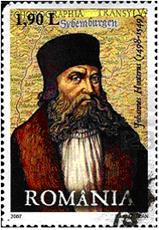
Johann Honterus, born Austen,
was a humanist scholar and a religious reformer of the Saxons in Transylvania.
His father, Georg Austen, a master tanner, belonged to the guilds, the incipient
bourgeoisie in Braşov, and ensured the financial means that allowed his son to
become a “learned” man. Johannes received a good education early in life, in
the schools from Braşov, which were then run by the religious orders. In 1520,
he left for Vienna, to attend the University there, a “papal institution” at
that time. It must be said that during the Reformation, beginning in 1520, the
University of Vienna suffered a great loss of prestige. In 1522, he received
the degree of Baccalaureus and in 1525 he was awarded the title of magister
atrium, issued to him under the name Johannes Holler Coronensis. In
1529, during the siege of Vienna by the Ottoman armies, Honterus sought refuge
in Regensburg, with the scholar Johannes Turmair-Aventinus, where he remained for one
year. In 1530, he was a professor at the Jagiellonian University of Cracow,
under the name of Johannes Georgii de Corona, Artium Magister Viennesis.
In the same year he published his first works, a description of the world and a
Latin grammar. His textbook Rudimenta Cosmographica (Elements of
Cosmography) expounded on Copernicus’s heliocentric theory, based on
elements of mathematics and astronomy. Only one year later, he was in Basel, a
centre of humanism in liberal Switzerland. Between 1514 and 1521, Erasmus of
Rotterdam was active in Zurich. It was here, in Basel, that Ulrich Zwingli
began his reform in 1519. He initiated himself in the art of printing and
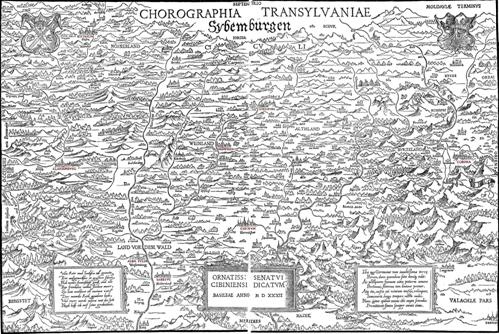
learned the art of woodcut. It was also here, in 1532, that he printed the
well-known cartographic representation of Transylvania entitled Chorographia
Transilvaniae. In 1533, Honterus returned to Braşov, where, two years
later, he was elected in the “Assembly of the One Hundred,” and in 1536 he
became a Communal Councillor. In 1533, in Braşov he established one of the
first printing presses in Romania (the first printing press had been brought
from Târgovişte by the monk Macarie in 1508, and from 1529 two other printing
companies functioned in Sibiu and Cluj, led by Gaspar Heltau, Magyarised as
Heltai). In 1543 Honterus printed Reformatio Ecclesiae Coroaensis ac toitius
Barcensis Provinciae (The Reform of the Church in Corona and throughout
Burzenland), which is the oldest printed work with a reformist content. It
was also in 1543 that he printed Apologia..., which explained and
defended the ideas of the Reformation comprised in the previous book. In 1547/8
he printed Kirchen ordnung aller Deutschen in Sybemburger (The Church
Ordinance of all the Germans in Transylvania) and Reformatio Ecclesiarum
Saxonicarum In Transylvania (The Reformation of the Saxons’ Churches in
Transylvania) which included the main tenets of the Evangelical Reform of
the Transylvanian Saxon Church, of Lutheran inspiration. By the end of his
life, he published 37 text books. At Honterus’s
insistence, the first paper mill in the region was founded in Braşov in 1546,
delivering paper also in Walachia and Moldova. Honterus was particularly
interested in educating the youth. He reorganised the old public school in
Braşov, which dated from 1388. In 1541, a new building was raised for this
school. A library was started with the public school, some considering it the
greatest in the region. He drew up a regulation for the functioning of the
school, Constitutio Scholae Coronensis (1543); he also founded a students’
organisation, called Coetus (Band), where the students had more
freedom of thought, decision and action, with a view to their easier integration
in life. Honterus Johannes died on 23January 1549.
The
historical achievement of Honterus was the reform of the community’s
Catholic Church, a reform that was accepted by the entire Saxon community in
Transylvania. This “national” organisation on religious grounds protected the
Saxons from Magyarisation in the nineteenth century. The diploma issued by King
Andrew II in 1224 stipulated: “Let them freely
elect their priests, let those elected be presented for confirmation”;
however, this last provision sufficed for the interference of the Hungarian
political power in the affairs of the Saxons. It was here that the new church
organisation proposed by Honterus intervened. This protection - the Lutheran
organisation - did not include the Catholic Swabians. Here are some facts: in
1914, there were only 417 German elementary schools for 1,903,357 Germans in
the territories of the Habsburg monarchy that were administered by the
Hungarians. In Branau County (or Turkish Suabia) with an overwhelming German
majority, there was already no German school left! Of the 417 schools that used
German as the language of instruction - 254 German schools belonged to the Transylvanian Saxons, who amounted to 234,085 inhabitants.
The other 1,669,272 Germans from the rest of the territories administered by
the Hungarians, namely the Banat, Crişana, Tisza Plain, Slovakia, Danubia and
Transdanubia had only 163 elementary schools. The explanation for this
situation is as follows: the Transylvanian Saxons had their own Lutheran church
with a bishop elected by the congregation. The Germans from the rest of the
territories administered by the Hungarians were magyarised and, with few
exceptions, Catholics, that is, they belonged to a church that not only had no
German character, but its primate was appointed by the government in Budapest.
Moreover, the Catholic Church, controlled by the Hungarian government, became a
highly effective means of magyarising the un-Magyarised believers.
Magyarisation was enforced not only through the church but also through
schools, the army, the administration, the daily intolerance of the
Magyarophones, through Magyarising culture itself. This explains, once again,
the total Magyarisation in Hungary despite the fact that the great majority of
the 1,669,272 Germans were Catholics but out of the 163 elementary schools with
German as the language of instruction only 79 were Catholic schools. 84 German
schools fell prey to the administration and 79 to the Hungarian Catholic
hierarchy. Another sad chapter was the Magyarisation of the Swabians in the
Banat and Sătmar, on account of the same Magyarising Catholic Church; deprived
of their “national” church, the Swabians brought by Maria Theresa during the
eighteenth century were an easy prey to the juggernaut of Magyarisation; here
Magyarisation continues even now, in the third millennium, because this
community has no divine service in their native language. What is peculiar is
that the Hungarians and the Magyarised converted to Calvinism under the
pressure of the Turks, who wanted to drive them away thus from the Catholic
Austrians, in the so-called phenomenon of “Calvino-Turkism,” which means that the
Catholics are mainly Swabians. In other words, the Catholic Church in Hungary,
whatever was left of it after conversion to Calvinism, had a trans-religious
purpose. It is against the background of this contrast of historical destiny
between the Saxons and the Swabians that the work of Johann Honterus can truly
be appreciated today. O.C.